




Attendance at Oct. 25 Riverside event keeps beloved historical structure standing
Special by Bobbie Maddox
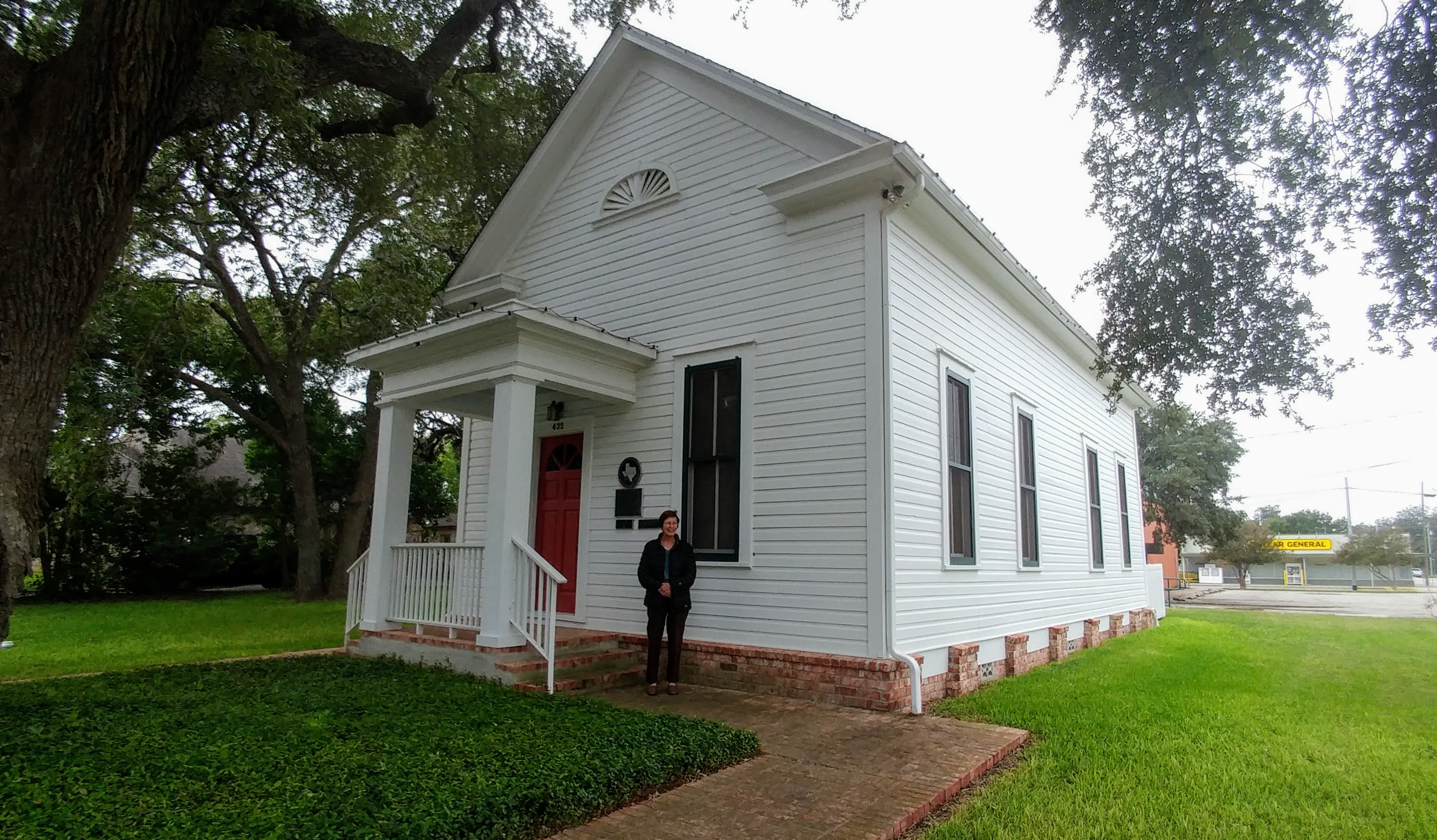
(Seguin) — She’s old, 123 years. Sitting alone on the corner of River and Ireland Streets, passers-by may wonder about her: “Is that a church?
“A wedding chapel…
“backstage of the Texas Theatre?“
But if they stopped and walked up on her porch, they would see the marker declaring her the first building dedicated to women’s meetings in Texas. This grand old lady of a building, for which women like Mrs. Josheph B. (Ella) Dibrell and Mrs. Edgar B. (Nettie) Nolte raised money to construct her, was financed by selling eggs and holding fundraisers.
Once her construction was finished in 1903, the Women’s Clubrooms served not only ladies’ study clubs, but was also a respite site for farmers’ families coming to town for supplies or to sell crops. She also lent her frame for a first, small library, and even served as a Red Cross site during WWI.
She changed locations four times, but now rests comfortably on her corner with Sudy the Squirrel (named in honor of Sudy Bruns) keeping watch beneath a sprawling live oak tree. Her front porch is welcoming, and today three study clubs, Shakespeares, Delphians and Seguin Study each hold regular meetings there.
The clubs were formed way back at the turn of the century to give women a place to gather and share their love of reading and learning. That purpose still exists today, as well as a site to rent for bridal showers or other occasions or meetings of local organizations.
Out of the original federation of clubs, the three responsible for the house and its upkeep today formed an affiliation, and each is represented by two members who keep their group informed and working together to perserve the clubhouse. Much of the ongoing preservation of the house has been dependent on funds raised from the Riverside Cemetery Tour in October.
“We love our historic building… but we are concerned more every year about covering the increasing costs of utilities, insurance, maintenance and repairs,”
Betsy Martin, president of the affiliation, said. “In the past 10 years we have had major repairs. We are hoping for the best attendance ever at this year’s Cemetery Tour because it is our only yearly fundraiser. Of course, we welcome any donations at any time!”
Besides the ancestors interred at Riverside, the 2026 Cemetery Tour, set for Oct. 25 at 2:30 p.m. will feature some visiting saints buried nearby. Perhaps the most prominent is the man for whom this town is named, Juan Nepomuceno Seguin, a Tejano military and political leader born in Spanish Texas Bejar (San Antonio) in 1806.
He fought in the Alamo, but after being sent to bring back reinforements, he found upon his return that the Alamo had fallen. Commissioned as a colonel, Seguin joined Sam Houston’s army and protected families during the “Runaway Scrape,” serving as rear guard for the Texian army and helping secure Texas Independence at the Battle of San Jacinto. Afterward, Juan Seguin served as a Republic of Texas Senator and Mayor of San Antonio. The town of Seguin was named in his honor in 1839.
Another nearby and significant descendant featured from Seguin’s history will be F.C. Weinert, 1853-1939. Weinert served as justice of the peace, county commissioner and county judge before his election as state senator and, eventually, Secretaty of the State of Texas. He is credited with bringing a water system, electricity and a dam to the community, making it one of the most progressive municipalities in Texas of that time.
Of course the tour of historic Seguinites also features the accomplishments of its women. Hilda Blumberg Weinert, born 1819, will appear to tell about why she was called “Mrs. Democrat.” She must have lived a non-stop life, having served Seguin’s School Board for 30 years and TLU as a regent for 20.
Hilda was a delegate to the National Democratic Conventions for many sessions, and a couple of U.S. presidents even commissioned her. Other saints at their gravesites will include Emma Krezdorn, born in 1881. She and her husband Herman “raised eyebrows” when they married. She will tell visitors to her burial site why, and about the jewelry store and foundation she and Herman started.
Martha Wegner Mattson Grolich’s family came from Hamburg, Germany by way of Baltimore, Maryland before landing in Seguin in 1901. She and husband Joe had a blended family from previous marriages. Joe started as a blacksmith and eventually opened a bar which he left Martha to tend after his “untimely death.”
Fredericksburg was the first Texas stop for Dorothea Suchart’s family when they emigrated from Germany in 1845. She married Edward Nolte and they raised seven children on the site now occupied by Starcke Furniture. The general store they started eventually led to the establishment of E. Nolte and Sons Bank. Their generosity and honest lending attracted the business of many local farmers.
Exekiel Smith, born in 1781, was an adventure seeker who traveled the
“Gateway to the West,” leading him to Seguin where he established a home and family with his wife Susannah Dingess and their eight children. He didn’t live a passive life, however. Exekiel fought in the Texas War of Independence and survived the Mier Expedition, a two year clash with Mexico. It was the Smith family that established Riverside Cemetery.
In more “recent” history, Dr. Clarence B. Friday brought his medical services to the Seguin community in the mid-1920s. He was Seguin’s first Black doctor, and despite segregation of the time, he treated patients of all races. He was recognized by the citizens of Seguin for his 25 years of devoted service before his death in 1958.
In addition to meeting this fascinating group of ghosts from Seguin’s unique history, Cemetery Tour patrons will have a chance to learn about Dia de los Muertos, or Day of the Dead. Teatro De Artes De Juan Seguin will erect a small altar, or “ofrenda,” to display examples of tributes to the deceased. Items such as photographs, candles, marigolds, foods and personal items representing those being remembered will be on display. Teatro representatives will explain the symbolism and purpose of each element and how families use altars to celebrate life, memories and family connections. Visitors will be invited to ask questions to learn more about this meaningful tradition.
The Riverside Cemetery Tour promises an afternoon of meaningful learning and entertainment. Tickets are $20 and available at Gift and Gourmet, Keepers, the Chamber of Commerce and The Guadalupe Trading Company.