




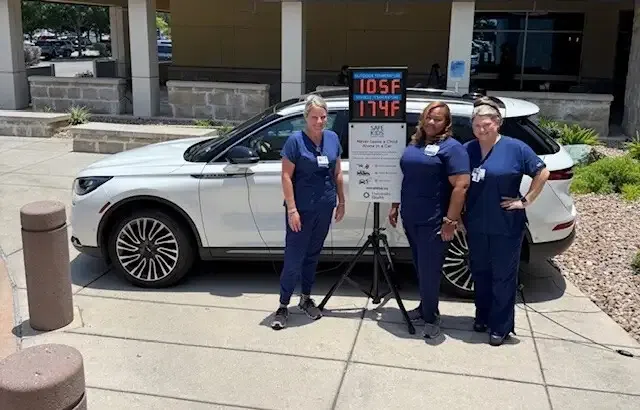
(Seguin) – A rising digital thermometer outside Guadalupe Regional Medical Center is doing more than just displaying temperatures — it’s delivering a life-saving message.
The outdoor display, set up near the Patient Tower entrance, visually demonstrates just how fast the inside of a vehicle can heat up during the summer. Amy Anderson, MSN, RN, trauma coordinator at GRMC, was among those who are helping to bring the message to the community. Anderson says they hope the real-time temperature reading will stop people in their tracks — driving home the “deadly risks of leaving children in hot cars, even for a moment.”
She says it’s a clear visual and urgent reminder of how fast vehicles can heat up — even with a window cracked.
“A car can heat up 19 degrees in just 10 minutes. And cracking a window doesn’t help,” said Anderson. “Heatstroke can happen anytime, anywhere. We don’t want to see this happen to any family.”
Anderson says the initiative follows a sobering national trend in which more than 10 children in the U.S. have already died this year due to heatstroke after being left in vehicles. Since 1998, at least 1,011 children have lost their lives to this preventable cause. Health officials report that children’s bodies heat up three to five times faster than adults, putting them at especially high risk.
Anderson says even while staff members were setting up the display, the importance of what they were doing was quickly realized.
“(In the picture sent), you can see that it was 175 degrees inside the car. Now, that was after it had been set up for several hours but even that morning, when we were setting it up at 10:30 a.m., it really wasn’t that hot outside but after about 15 minutes, it was already 125 degrees inside the car,” said Anderson.
Anderson when it comes to preventing these tragedies, everyone has a responsibility.
“I think in our world today, people are just so distracted with everything going on and people are just busy, and I think it really happens more with people that maybe dropping off kids that day is not part of the normal routine. So maybe mom drops off the kids every day and today, dad is going to take the kids because mom has somewhere to be and it’s not dad’s normal routine and maybe he is late for work, he’s distracted and taking phone calls and things just happen,” said Anderson.
To help prevent these tragedies, GRMC is promoting the ACT safety campaign:
Avoid heatstroke-related injuries by never leaving a child alone in a car—not even for a minute. Always lock your car when it’s not in use to keep curious kids from climbing in.
Create reminders by placing a visual cue in the front seat, like a stuffed animal or your phone, whenever your child is in the back.
Take action. If you see a child alone in a car, call 911 immediately. Emergency responders are trained to act quickly in these life-or-death situations.
For more information on how to prevent child heatstroke deaths, visit www.safekids.org/heatstroke.