




(Seguin) — The state of Texas is sending more resources to Guadalupe County to help with the fight against COVID-19. A joint statement was issued this week by GRMC, the city of Seguin, Guadalupe County and the Texas Division of Emergency Management announcing the expansion of the regional infusion center in Seguin.
GRMC, for months, has been offering the monoclonal antibody infusions to COVID-19 patients, who have mild or moderate symptoms. The treatment has helped dozens of people recover from the virus, and the extra resources from the state should allow them to help even more people.
GRMC Trauma Coordinator/PHE Director Amy Anderson says the infusions have been offered at the hospital since the end of last year, and this expansion is welcomed news.
“When the FDA first released the monoclonal antibody infusions, we started doing them for patients in the community on a very small scale. We were only getting maybe a couple of referrals every few days. It started to grow as COVID (numbers) started to grow, especially with that second surge — like in that January/February timeframe. We’ve actually continued to do them throughout this entire pandemic from December (2020) up until now,” said Anderson.
As COVID cases began surging again in June, Anderson says the demand for the treatment became much, much higher. She says that’s when they started pulling existing staff off their normal duties so that they could provide more infusions to patients in the community.“When we started with this third surge, we started doing them on a larger scale, and started pulling registered nurses that were non-clinical, non-bedside nurses to help with the infusions. We had people, like from the quality department (and) case management that were helping us do the infusions,” said Anderson.
The infusions have largely been working. People have been getting the treatment and then going home to recover, which Anderson says helped out on a couple of fronts.
“Several weeks ago it got to the point where we were doing close to 25 to 30 a day. We really felt that it was important to do those infusions for the community, because we felt not only that it helped the patient; but we felt that it was helping keep our hospital numbers lower than what they potentially could have been, had we not been doing those infusions,” said Anderson.
Anderson says this new partnership with the state will allow even more people to receive the infusions. It will also allow some of those borrowed workers to go back to their regular jobs.
“Prior to this announcement and prior to getting approval from the (Texas) Department of Emergency Management, GRMC really had been in a partnership with the county, because we were using (off-duty) paramedics. We had been pretty much running the infusion center on our own, seven days a week for eight hours a day. We were doing anywhere from 25 to 30 infusions, and it was just really getting overwhelming. And really, it was a seven day a week, 24 hour a day job for somebody. Whether it was me answering the phone or our chief nursing officer answering the phone — not that this isn’t important work, but we were really taking from people that had other full-time jobs that needed to be done as well,” said Anderson.
The state is providing extra staff that will essentially be able to take over much of the operation of the infusion center. Anderson says they are pleased that the state recognized their needs and honored their request for help.
“We put a proposal together to ask for help — from the Texas Department of Emergency Management — with getting extra staff to not only help give the infusions, but with like administrative staff as well that would help with scheduling and registration and those types of things. We got approved for that last week. Starting today (Tuesday), we just had our first group of contract staff come in and they are being trained (Tuesday and Wednesday). The thought is that, we as a facility will be providing the medication for the patients, but the agency that we are contracted through will take care of all of the legwork as far as administration of the meds, all of the scheduling and registration of the patients (and) calling. All those types of things. So that our employees can still get back to their regular jobs,” said Anderson.
The extra help from the state also means that getting in to receive the service is also being made easier. Whether you have a doctor or not, they will be able to see you at the infusion center.
“Prior to the state coming in, you had to have a physician referral from a primary care doctor or like an urgent care type center, along with your positive test result in order for us to do it. One of the big things that’s going to change now that the state is here, is we will have a walk-up process. We do have providers on-site. There will either be a nurse practioner or a physician here that can evaluate a patient that has a positive test result, and then we can get them set up with the infusion. So that should help anybody uninsured. There’s no charge for that. Anybody that’s uninsured or who doesn’t have a primary care doctor (is helped). We don’t want to limit patients that are eligible for this. That’s one of the main things — if you don’t have a PCP, we will have a walk-up referral process and you can be seen by one of the practioners that’s contracted through the state. So if you need qualification, you can get your infusion that way,” said Anderson.
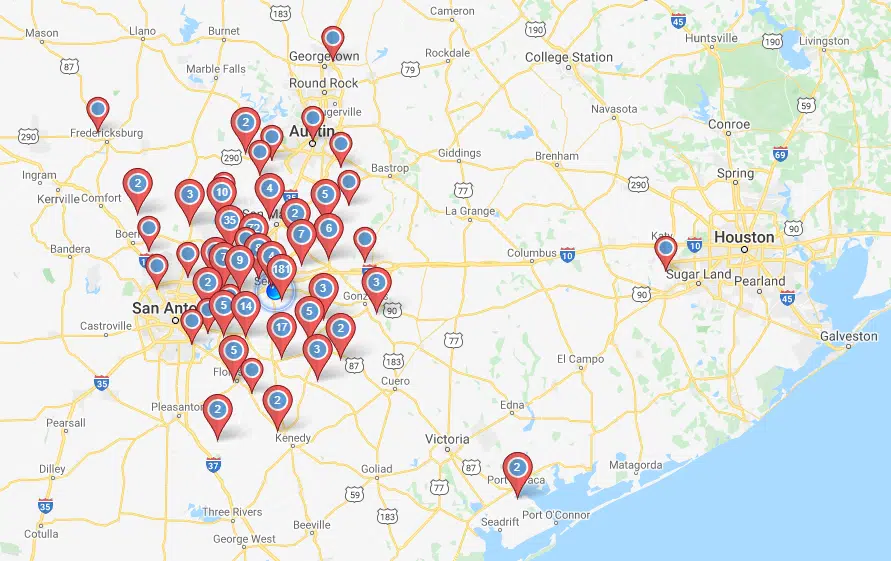
GRMC is jointly owned by the city of Seguin and Guadalupe County, but just like its name suggests — it’s a regional healthcare provider. Anderson says when it comes to providing the infusion treatments GRMC serviced patients from many surrounding counties and well beyond those areas as well. The treatment was not readily available in many of those places, which is why so many people came here to get treated.
“We got referrals from most of the New Braunfels doctors…we’ve gotten (them) from really everywhere — San Marcos, Austin, we had people come from Dripping Springs. We’ve had people come from all over because they are not able to get it anywhere close to their home. So it was really important for us to try to serve as many people in our community as we could, and be available to other communities as well,” said Anderson.
Patients must meet a certain criteria in order to receive the infusion. The treatment is meant for COVID-19 patients, who are not yet seriously ill.
“There’s certain criteria for people to meet to be eligible for the infusion. The thought behind the infusion is that you get it early on in the course of your disease to help slow down the viral replication and prevent the disease from progressing from mild or moderate symptoms to severe symptoms where you end up having to be hospitalized,” said Anderson.
Although patients must qualify, Anderson says most people, who are not yet seriously ill, will be able to qualify after a positive test. She says there’s a wide range of factors that would allow someone to qualify for this service.
“The qualification factors, which include anything from a body mass index above 25, if you’re over age 65 that automatically qualifies you, diabetes, high blood pressure, (and) pregnancy. There’s a long list of things that you can meet qualifications with. (But you must also have had) symptoms less than 10 days and a oxygen level above 90 percent on room air,” said Anderson.
Anderson says this treatment has shown promising results, but it’s important that people not wait too long to get help. People sometimes want to wait to see if they will just start to feel better. She says that’s not something you should do in this case.
“There’s been a lot of people when I call to schedule, they’re like — ‘well, I don’t really feel that bad. Can I call you back in a couple of days if I start to feel worse?’ We advise them that the way the medicine is supposed to work, is that it’s supposed to go in as early as possible. If you continue to feel bad, that means the virus is replicating and it’s making you sicker. So for the medicine to work effectively, the earlier you start it to slow down that viral replication — is where you are going to have the best results,” said Anderson.
While the infusion treatments generally continue to help people with mild and moderate cases, the hospital still says that it’s best to try to protect yourself from getting the disease. They say you should get the vaccination if your doctor says you are an appropriate candidate for it. You should also wear a mask when you go into public indoor spaces, you should practice social distancing whenever you can, and also remember to wash your hands frequently.
Patients can contact the infusion center by calling {830) 481-4332. Doctors can contact the infusion center to obtain a referral form by faxing a request to {830) 401-8267. Texans can visit https://meds.tdem.texas.gov or call 1-800-742-5990 to find the nearest infusion center.