




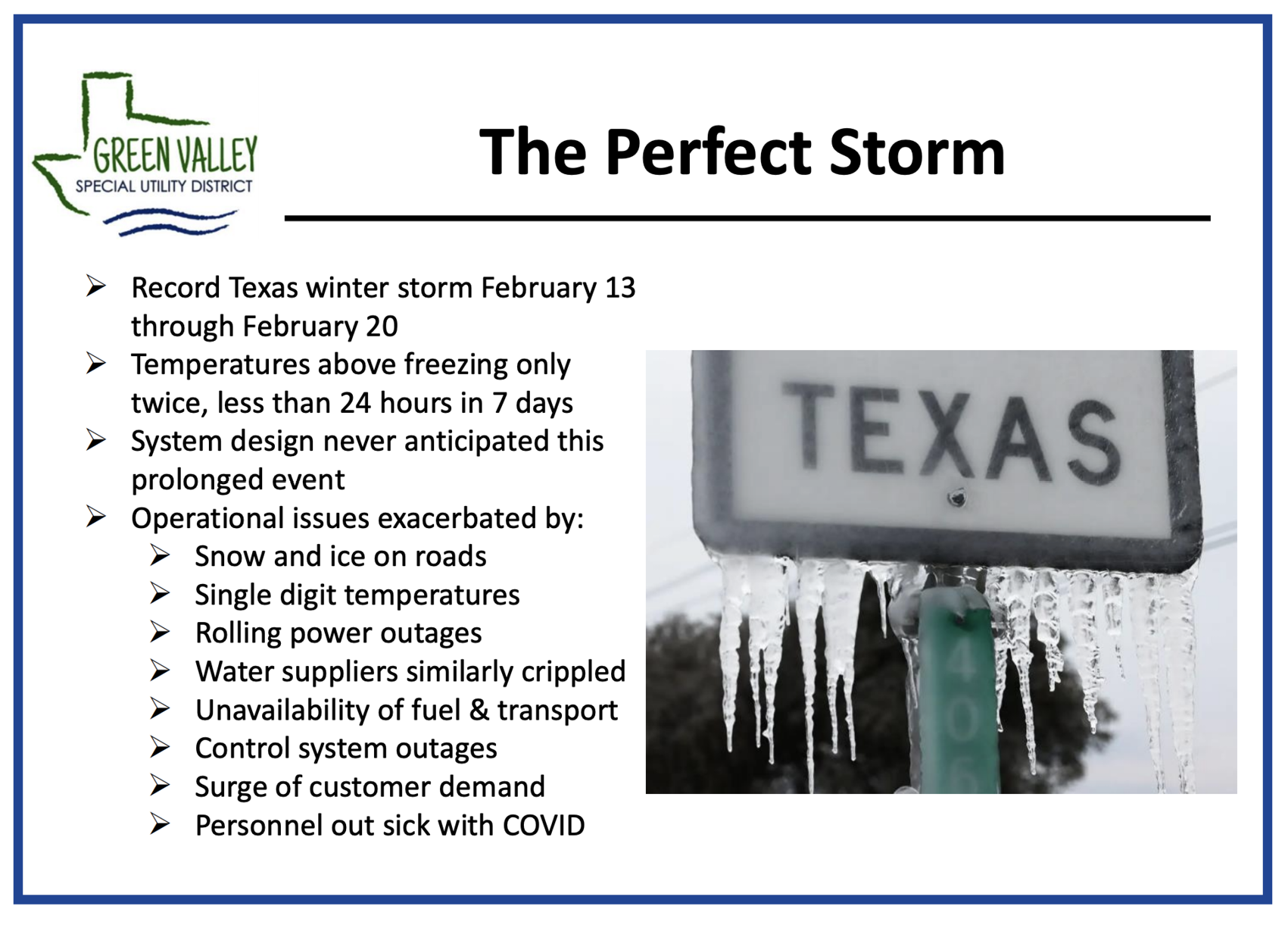
(Seguin) – What did we learn? What are we going to do about it? Although it has been almost two months since Texas was blanketed with a hard to forget historic winter storm, the vision to understand exactly what happened and how to better handle things has at least one special utility district speaking up. Going over its experiences during Tuesday’s meeting of the Guadalupe County Commissioners Court were officials with the Green Valley Special Utility District. Jim Poage, the board’s vice president, says memories of Feb. 13-20 are still vivid for most folks. He says with temperatures above freezing only twice, less than 24-hour in seven days, its system design never anticipated this prolonged event – forcing many of its 14,000 residents to go without water.
“The operational issues were exacerbated by things like icy roads and power outages and just the ability to get around and our controls systems were freezing up. We had personnel that were out sick with COVID. I’m not sure how you can identify anything else that could go wrong that would have affected us negatively, but it seemed like they were all there,” said Poage.
Poage says behind the scenes, Green Valley was forced to tally a list of issues – issues that even they wouldn’t have ever imagined.
“In terms of the numbers, we had five major line breaks during that period of time, 125 hours of continuous time below freezing during that period. Many of that in single digits. We had a lot of customer complaints. Over 8,000 customers were affected that we know of. There may be more than that because at times, our control systems didn’t tell us when things were at low pressure because they were frozen and so it may be reading high when it was low. We had 18 of 42 employees out with COVID. That only left us with 10 linemen to work 500 miles of pipeline so with four water wells, 11 distribution points, 12 different water entry points, we racked up the overtime like crazy,” said Poage.
Poage says throw in not having power, then many of the issues become out of your control.
“We have 500 miles of pipeline and what we try to do is have redundancy and flexibility and reliability built into that so if one system goes down or a pump or a line breaks, we’ve got another way to get water somewhere. The problem with that is when you’ve got four miles of pipe for every square mile and our service region is 127 square miles, one power outage can just blank out a whole bunch of those pumps and when that happens, you lose the ability to move water from point A to point B. So, you may have water over there, but you have no way to get it to anybody because the pumps won’t run,” said Poage.
Poage says like other sister utility companies, everyone heavily relies on each other to help provide the necessary services to customers. Green Valley officials say when “our partner’s suppliers stumble, our partners stumble and we stumble.” Poage says for Green Valley, such partners include GVEC, Canyon Regional Water Authority (CRWA), CPS Energy and Wells Ranch.
“The water and power both were up and down on an intermittent basis. The difficultly not only in finding water, but we have back up generators in lots of places but after a while, we started running out of diesel fuel and with ice on the roads, we couldn’t get anybody to come out and fill the tanks,” said Poage.
On the Friday before the storm, Poage reports that the company went out and did a lot of preparation.
Poage says while they’ve learned a lot, a lot of those changes won’t be easy as they still have to be made with their customers in mind.
“So, the planning has already started. We’ve already got a list of things and of course, you know, we don’t know if this event will happen in five years, 50 years, never – I mean we don’t know and so, there’s one school of thought that says ‘well, if you plan and put it all in place so that if it happens next year, we’d be perfect. Nobody can afford those rates. That’s a huge amount of money for something that may or may not happen for a long period of time and so we are trying to figure out where we get the most bang for the buck. What are the things that we can do that gives us the most impact with the least amount of cost because if you recognize, our customers are our only source of revenue,” said Poage.
Poage says among the plans is to better work with partners so that next time, they all have a better idea of what is going on and how it is impacting each other.
“Working with the partners is really important. For example, one of the things that we found out was it would be nice if we knew what some of our partners were looking at in their control rooms. We could see ours, but they couldn’t see ours and so there are mechanisms that we could look at each other’s systems to be able to say, ‘okay, where is that blackout right now? What’s the water doing over there? What’s this location doing with their water? Do they have water in those tanks?’ And other people looking at what we are doing. So, that kind of technology and those kinds of discussions are going on with our engineers right now to see what kinds of things we can do to better prepare,” said Poage.
Green Valley officials say they will continue to compare ideas and proceed in a cooperative effort. They say with 17 new subdivisions in their service area, learning from February’s experience is crucial.
Poage says every solution has a set of pros and cons that come with it. He says you simply can’t just store more water or more diesel for a historic event that has not yet been written.
“You have to use water. You can’t just store it there and leave it there for a long period of time. It gets old. So, during the wintertime, when there’s lower usage of water, you keep these tanks at a lower level than you do at summertime when you are using a lot of it. Well in retrospect, fill everything right up to the brim, yeah, we should have done that. We didn’t quite think this was going to happen. That’s one thing that we don’t even have to spend money on. The next time we see one of these coming, man, we are going to jam as much water into those things as we can plus, we are probably going to end up building more storage tanks. But, you have to be careful because in the north, this happens every day for months and so having systems that are built like that – electrical systems and backup systems and so forth is one thing – having it when it happens every 10, 15, 20, 50 years, that’s something else,” said Poage.
Green Valley officials also reported that it has reworked its crisis communication plan for the public. They also added that fortunately, the record winter storm did not majorly impact their budget and that customers did not have to worry about receiving a higher bill. Instead, they were billed for the lesser of their January or February utility bill.