




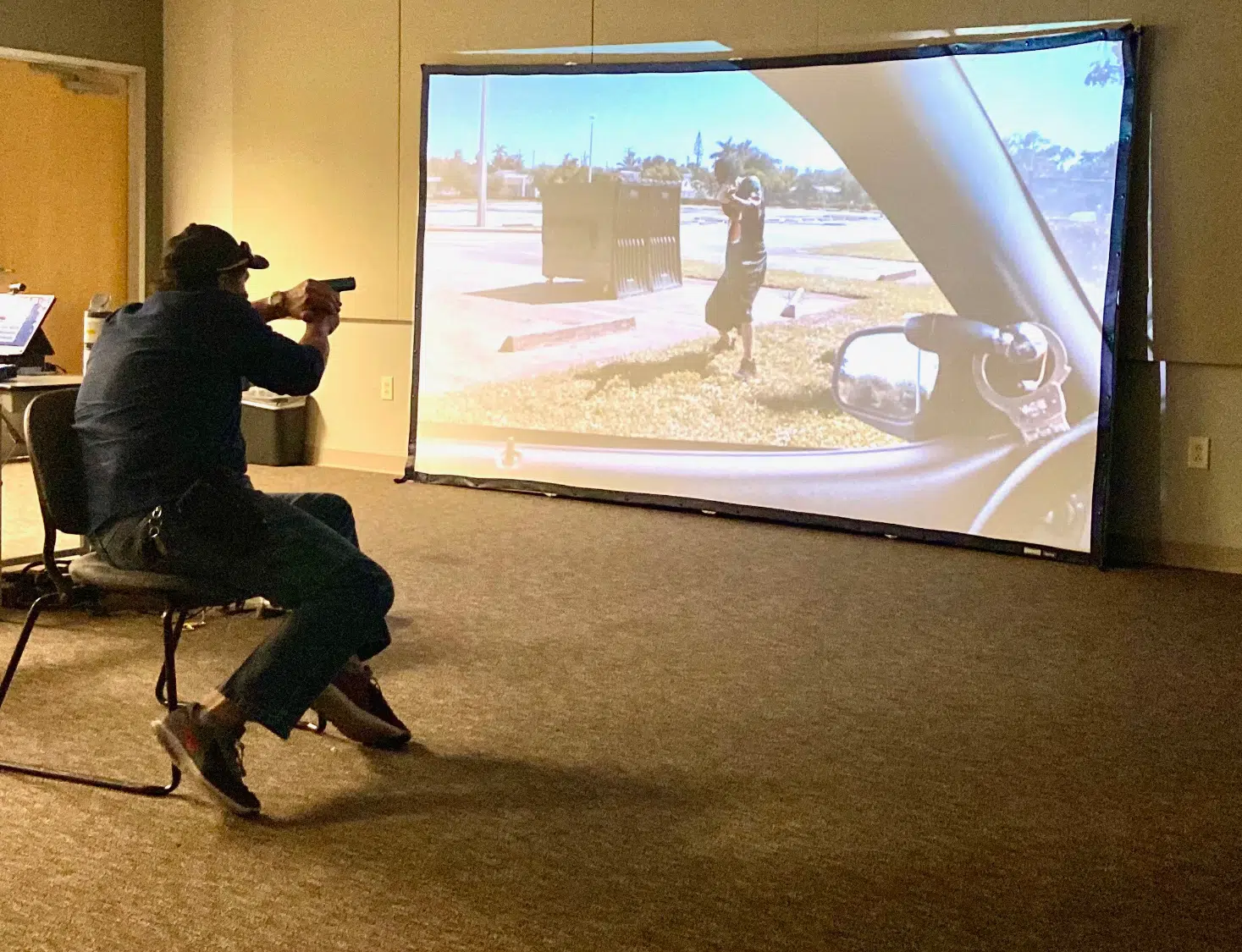
(Seguin) — A bad day in the office for most of us means that we may go home in a grumpy mood. A bad day at the office for the men and women in law enforcement could mean that someone ends up dead. It’s a reality of the job, and it’s one of the reasons why law enforcement agencies spend some much time and effort making sure that their officers are well trained and that they are ready to handle any situation they encounter.
The Seguin Police Department recently got a demonstration of a piece of technology that’s designed to help officers be ready for any scenario they might face. Ti Training recently brought its simulation training system to Seguin, and allowed officers and members of the community to have a chance to try it out.
Todd Brown, a long time member of the law enforcement community, serves as the company’s vice president. He says his company provides this state-of-the-art training tool to agencies all across the country.
“We are Ti Training. We are out of Golden, Colorado. We produce interactive simulation systems for law enforcement training. We began our company in 2006, and to date, we have over 1,200 agencies here in the United States that utilize our simulation systems,” said Brown.
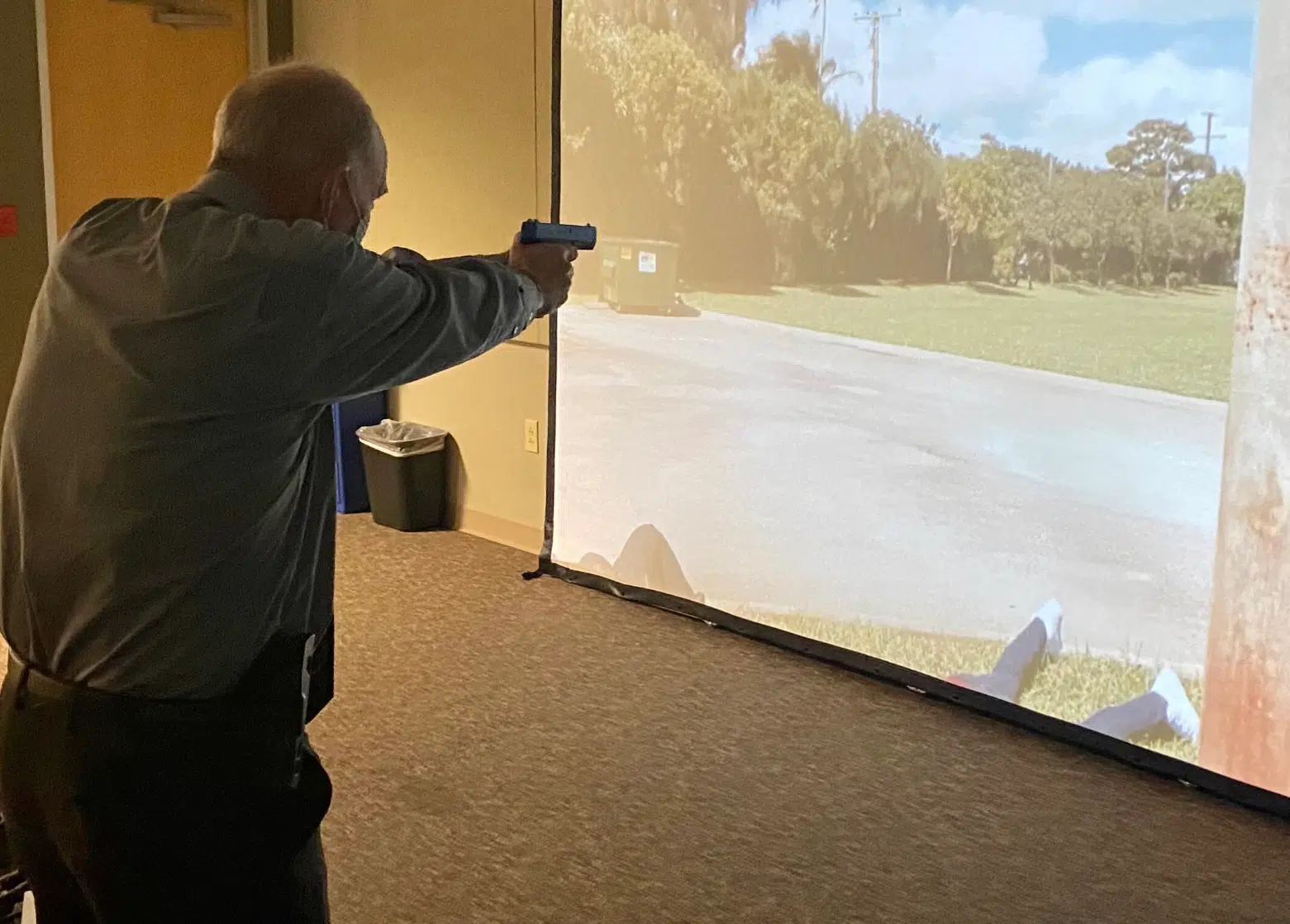
Seguin Police Chief Terry Nichols battles virtual bad guys on a simulator.
Seguin Police Chief Terry Nichols wanted his officers to see how they felt about the simulator, but he also invited some members of the community as well as the mayor and some members of the city council to the demonstration. Nichols says he wanted to give the public an opportunity to see some of the ways that they can go about training their officers.
“I think it’s important for the community to see what we are trying to do at the department. I think that we are trying to leverage the latest technology out there for decision making, for use of force, for everything that we do — and technology, like the Ti systems that we are seeing today, is exactly that.
Nichols says he wanted people to not just see this sophisticated piece of technology, but he also wanted them to witness the challenges that police officers face when they receive a call for service. He says the simulator can change the scenario in real-time based on feedback from the officer, and it shows how quickly things can go from good to deadly in less than a second.
“That’s what is so neat about these types of systems. You can run the gamut, and one of them is what you talked about. (You) can let our community know just how fast things happen. Some of you in the room actually got to participate and see that things can go bad real fast. Our police department, our law enforcement officers are professionals and they are trained to deal with this. But again, it can go bad real quick, and this allows us to practice in an environment where no one gets hurt and we can pause, rewind, look at what we did and see if we need to make a different decision. But it is nice for the community to be able to come in and see it as well and get experience with — ‘ah, that’s why the police officer asked me to do X when I was on that traffic stop,”‘ said Nichols.
Chief Nichols invited me to take a turn in the simulator. I have to admit that my heart began to race just thinking about it. The simulation called for me to respond to an alarm call at a warehouse, and there was already an officer on the scene, but he wasn’t responding to dispatch. When I rounded the virtual corner, I could see the officer on the ground with a visible wound, and a man kneeling next to him. The man picked up the gun. I ordered him to put it down, and he tried to explain that it was a misunderstanding. Here are the details of my interaction with the simulation and how it all played out.
Me: “Drop the weapon.”
Simulation: “No, no, hey, hey, this isn’t what it looks like.”
Me: “Drop the weapon.”
Simulation: “It isn’t what it looks like.”
Me: “Drop the weapon, right now!”
(MULTIPLE SHOTS ARE FIRED)
Audience: “You got him.”
I did get him, but what the audio doesn’t tell you is that I may have shot the male suspect in the simulation, but in truth, if I was actually a police officer in that situation, I might have already been dead. Even though I had my gun pointed at the man, he still fired first, and it was an intense demonstration about how little time officers have to react to a clearly deadly situation. This simulator lets the officers experience all of that in a safe setting, so that they are able to better respond if they find themselves in a similar situation.
Brown says their simulation systems can be used for a number of training purposes, including as a tool to educate the public about the work of law enforcement professionals.
“I guess the biggest takeaway that I hope that they learn is that — how hard law enforcement agencies are trying to train their officers to safely interact with the public on a daily basis. Simulation based technology is a way for them to do that. (They can) make a mistake in a safe environment, maybe repeat the scenario with corrected behavior, so that the officer can learn the most effective decision-making tools possible and that they can then take with them out on the street,” said Brown.
Part of Chief Nichols invitation for the demonstration included members of the Community Coalition. The coalition is a group that has been working behind the scenes in Seguin to begin to address the relationship between police officers and the African-American community. It is still a relatively small group, by design, that includes some elected officials, law enforcement leaders, members of the Black Lives Matter movement, and local pastors from some historically Black churches in Seguin.
Rashad Tolbert, president of the Black Student Union (BSU) at Texas Lutheran University is part of the coalition. He also took a turn in the simulator (admittedly, he did a better job than I did). Tolbert says he sees how this tool could be beneficial, but he also asked if they had ever considered creating scenarios that showed the opposite perspective. Right now, you see the scenario from the officer’s perspective, but Tolbert said what officers could also experience in the training is watching from the perspective of the people they might encounter. Chief Nichols liked the idea, as did Brown, who said that he would be sharing that idea with the folks who put together those videos at his company.
Chief Nichols says they are considering purchasing the simulation system, and adding it to the training tools and resources that it already provides. The basic system costs as little as $42,000 and can be tens-of-thousands of dollars more based on additional features
Nichols says if they purchase the system, it could also be used for training for both officers and the community.