




(Seguin) — Now that “most” areas of the water in the Guadalupe Valley lakes system are officially open, GBRA officials are warning residents to still enter with caution.
The Guadalupe-Blanco River Authority Board of Directors spent much of the afternoon on Wednesday repealing and replacing an ordinance that initially kept all people off the lakes. The action was enforced in September and was part of a temporary injunction agreement between the river authority and plaintiffs in a lawsuit who were working to stop the draining of the area lakes.
The replacement of the ordinance was to conform to the findings released on Monday by an Independent Expert Panel that was tasked with studying the safety of the lakes. As per the court’s temporary injunction, the areas not identified as unsafe “automatically opened.”
Patty Gonzales, the communications manager at GBRA, says this week’s amended ordinance will help with the continued enforcement of those restricted and unsafe areas.
“GBRA will be conferring with the Guadalupe County Attorney and if he has no changes, we will publish the ordinance and it will take effect in approximately two weeks after that. The previous ordinance that was repealed (Wednesday) stated that there was absolutely no activity on any of the lakes so this ordinance makes the changes based on the Independent Expert Panel report,” said Gonzales.
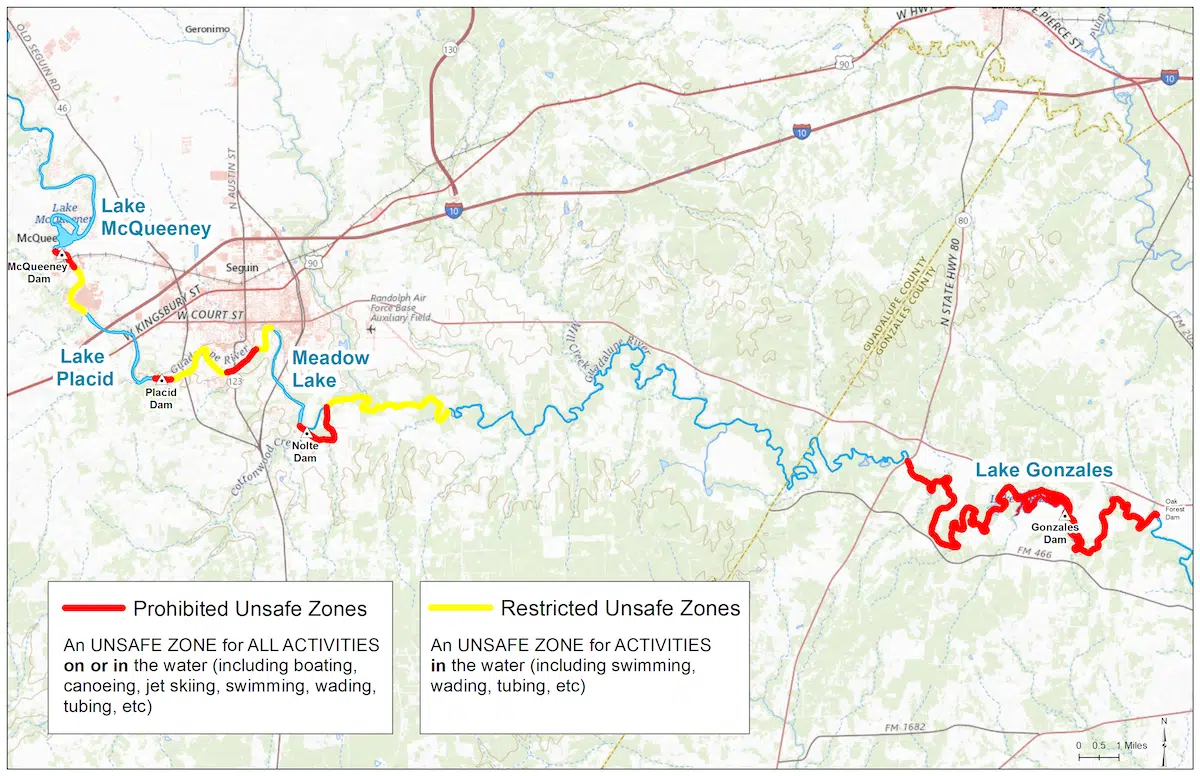
Despite word that parts of the lakes are now open, Gonzales says residents and lake users should not be too fast to jump in. Instead, they are encouraging them to map out the safe zones as well as those areas clearly off limits.
“The lakes are open except for the unsafe zones. So, the prohibited unsafe zone means absolutely no activity. The restricted unsafe zone, you could consider semi-opened in that the only way you can access it is via watercraft wearing a Type I or Type III personal floatation device or life jacket. So in the restricted unsafe zone, there is no swimming, wading or tubing,” said Gonzales.
In a written statement released this week, GBRA officials say “understanding that nowhere in, on, or immediately adjacent to the water can be deemed 100 percent safe.”
Gonzales says the prohibited unsafe zones that are still in place pretty much reflect the original areas of concern.
“A great part of the report affirms what we laid out previously in terms of the prohibited areas surrounding the dams,” said Gonzales.
As outlined in the report, GBRA officials will begin implementing additional signage and buoys to clearly mark these areas. GBRA will also continue to monitor the prohibited areas surrounding each dam and will be working in coordination with local law enforcement to enforce these restrictions.
Again, to help further assist lake users, maps clearly outlining the prohibited and restricted zones on each lake have been created.
Those maps and all other additional information can be found online at gvlakes.com.