




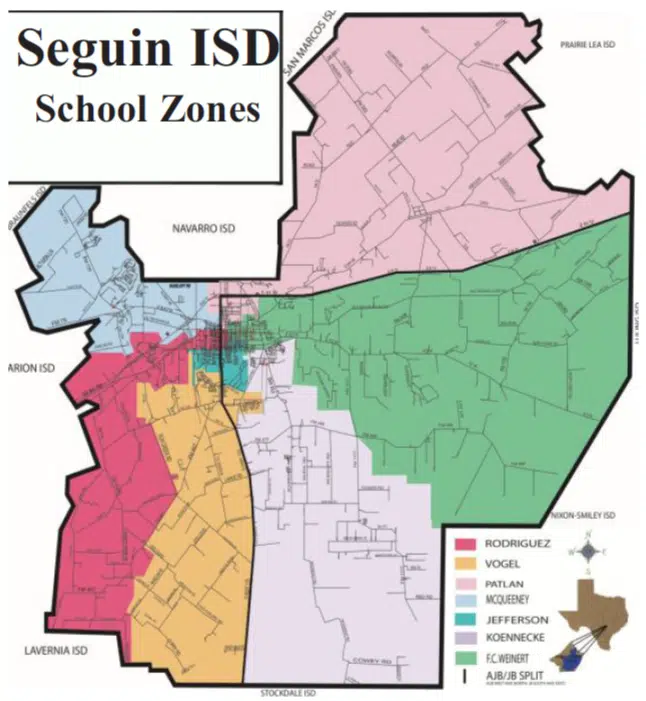
(Seguin) — The Seguin ISD is looking to balance the enrollment of its campuses district wide. The school district has officially begun the process of redistricting its school attendance zones.
Dot Whitman, assistant superintendent of administrative services, says it’s been 10 years since the lines were redrawn.
These are the lines that have led families to their designated schools in the Seguin ISD.
“Part of the redesign or the redistricting of the attendance zones is obviously for possible student growth and right now, we look at our porportions at our different campuses and obviously we do need to address the enrollment in the discrepancies at each campus. We want to balance the enrollment as much as possible especially at our elementaries. Right now, Koennecke is probably one of our largest with Rodriguez right behind them and they are on each side of the community. We’ve got Weinert that is landlocked. Patlan is growing tremendously and then we have to look at where we are going to be with Jefferson on expanding the new bond information with new construction at Jefferson, what impact that will have. McQueeney, possibly moving McQueeney to a different location and obviously Vogel so there are a lot of discussions that need to be had. Then, we also have to look at our alignment at our middle schools. Right now, I think Barnes is about 90 kids higher than Breezy and so that causes some equitable concerns with staffing and those things but then we have to wait and look and see what the demographer will say with the Vogel housing coming up because that will be adding obviously to Breezy,” said Whitman.
Whitman says there are lots of moving parts and lots of dynamics when it comes to redrawing the attendance lines.
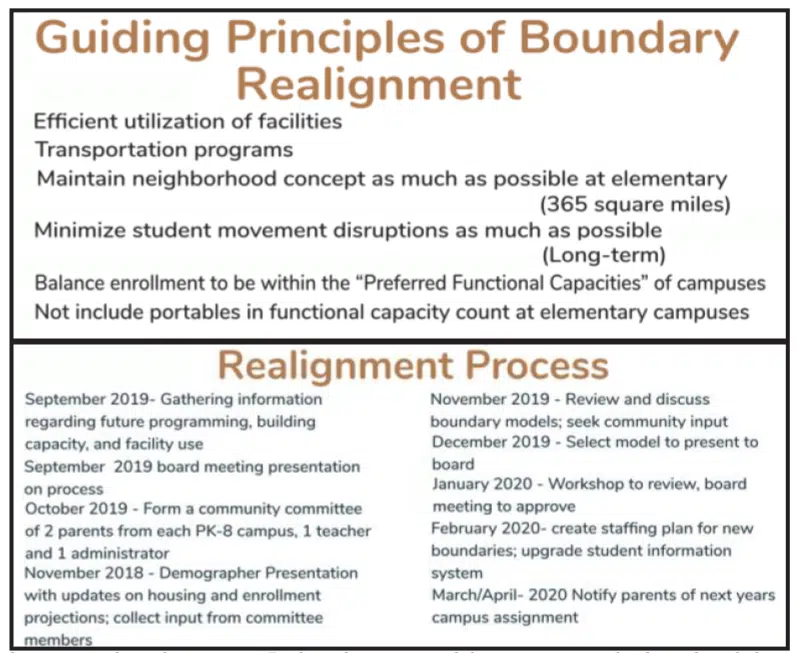
“Some of the guiding principles that we are looking at for the realignment — obviously, we want to be efficient with our utilization of facilities. We’ve gone through that already with you guys with the facilities commitee and looking at our campuses that didn’t have enrollment and what we are doing with those. One of the things that is also going to happen if we do the realignment especially with the Pre-K is the transportation piece. We can possibly do away with half day. If we are going full day four year-old, then right now, we are transporting kids at 7:30, 11:30 and 3:30 so I mean there is constant movement with busing of kids at half-day and then if we do have a bad weather day, we lose half of those kids anyway. They won’t come. It’s not worth their time coming for two and a half hours. Back in the 90s, the neighborhood concept was developed to keep the elementary schools in the neighborhood. That is going to be continued. I think that was a goal of the community back then. So, we will be looking at how that still looks wtih the growth that is coming. We want to minimize student disruption but that’s long term. Right now, it will disrupt when we look at the boundaries but long term, what can that be to help and sustain where kids are for maybe another 10 years and that wouldn’t be too unreasonable to look at,” said Whitman.
Whitman says the current facilities and programs are also heavily considered when trying to draw the new lines.
“We want to look at our preferred functional capacity which means what do our buildings hold without the portables. That is not something that we positively want to add onto our campuses so we want to look at what our capacities look like without the portables. Other considerations, we have a lot of programs that we are running so we have to look at our strategic design. That goes into what our EA classrooms look like, what do our dual language classrooms look like and what do our Liink classrooms look like. So as we invest in our programs, we’ve got to have those strategic designs to meet the needs of sensory units. We are going to have to look at A.J.B. What does that do when we look at a new modern middle school and what do those learning centers look like. We are going to take some trips to see some schools so that will give us an idea of what that looks like. Staffing cost, can we be a little bit more efficient if we reduce maybe where our programs are offered and condense the hard to fill areas such as bilingual and special ed, behavior and EA — can we look at condensing those programs at specific campuses to help reduce our own staffing costs,” said Whitman.
School feeder patterns, which help designate the schools that students follow as they graduate, will more than likely change. District officials say right now, the Seguin ISD has pretty distinct lines in certain cases. Guadalupe Street currently divides the middle schools while Interstate 10 divides other sections of the school map. They say equitable staffing will also have to be considered when creating new attendance zones. Whitman says the Seguin ISD pledges to be as transparent as possible while undergoing this process and again states that there are many, many things to consider district wide.
“These are hard decisions to make as far as going through redistricting because it’s mainly moving kids and maybe where families thought their kids would be going. So, there’s processes that we put in place. So if you have a student that was at Patlan since kinder and they are in fifth grade and maybe their zone is affected, then we’ll do some grandfathering with not only fifth graders and eighth graders but also those siblings as well and then the impact that the full day pre-k. We piloted our pre-k classroom at Patlan. I think it’s going pretty well. We’ve got little ones walking that hallway. We’ve got 15 kids that are full day in a comprehensive campus so we are looking at possibly expanding that to two other campuses so that will be three campuses that have full day pre-k which will eliminate some of the overcrowding at Ball to increase more kids at Ball Early Childhood,” said Whitman. The district this week is launching a fully detailed schedule of how this process will unfold before the community. Whitman shares what’s expected for the rest of this year.
“In October, we will be working with each campus to get a representation from parents, staff and community to make up a committee to help us go through this process. In November, that’s when we will have a independent demographer present the updates on where the housing is, what the enrollment projections look like and then also collect any other input they may see from the committee’s perspective and I think the last time the demographer was here, that is pretty eye opening on how detail they can get and what the projections look like. The last part in November, we will be reviewing and discussing what the models look like and have some final community input. December will be the time to select a model to present to the board and then we take a break,” said Whitman.
The work of rezoning well then resume in January. Whitman says the goal will be to have the lines announced by March or April of next year.
“Coming back in January, then there will be a detailed workshop to the board with the demographer and hopefully with the committee to present the model selected. February will be rolling out the new boundaries and upgrading student information and also staffing. That was a big big move 10 years ago. So, you give staff maybe some input on where they might want to transfer. They get maybe some selections on what grade level they want to teach so we try to get some input first before final assignments are made and then March, April, the parents will be notified officially what campuses their kids will be assigned. Obviously, this will be very transparent from day one so parents wont’ be surprised in March to hear. We will keep this on the forefront and make sure the community is aware of what direction we are headed with the boundary and rezoning,” said Whitman.
Whitman’s presentation to the school board was among the first steps in launching this new rezoning effort for the school district.
The Seguin ISD’s redistricting schedule will be made available on the district’s website.
The website can be found at www.seguin.k12.tx.us.